
The Liquidity Swap Drop: A New Kind of IDO
Neil Zumwalde
2021/06/02
const serializers = {
  types: {
    code: (props) => {
      return (
        <StyledCode>
          <SyntaxHighlighter
              useInlineStyles={false}
              language={props.node.language}>
            {props.node.code}
          </SyntaxHighlighter>
        </StyledCode>
      )
    },
  },
}
UPDATE After Day 2:
Since we’ve stabilized in the high $.30s, we’ve decided to delay some price reinforcement (Liquidity Drop, Step 2) to the cleanup phase, when the discovered price will represent the value after the pulldown. It commits Credmark to financially supporting the higher price after the late buy phase.
UPDATE After Day 1:
On mainnet, downward price pressure from swaps was 64% higher than in our Ropsten testnet simulations. Consequently, we decided to lower the swaps to 62500 CMK (25% of each drop).
Original Article
Credmark is building a highly incentivized community of governance participants and data modeling contributors. The first step in this journey is to create value for our community. In order to do this, we’re launching a Credmark token (CMK) on Uniswap v3.
We have several aims for this launch.
- We want to make sure that the token is in the hands of people that want to see Credmark succeed, and will participate in the platform. We want to make sure that the token is decentralized, with a wide distribution to cover everyone’s interests democratically.
- We want to know the market value of the upcoming Credmark platform.
- We want the token to hold its value in the low-liquidity early days of its existence. We want to make sure that the mechanisms exist for deliberate value growth, so people can rely on its value while putting in sweat equity creating data models. We want the value to be maintainable, and somewhat predictable, so our community members can rely on it during its early days.
- We want to discourage front-running and pump and dump schemes.
LBPs (Liquidity Bootstrapping Pools) on Balancer are historically efficient at retrieving permissionless distribution and price discovery. This is achieved through utilizing a falling price mechanic to find the public appetite for the token. LBPs create assets that, after the public launch, have low liquidity and volatile price structures, a boon for meme-able trading tokens, but a liability to steady growth projects that require reliable value.
Uniswap v3’s permissionless mechanics allow for the same price discovery and distribution mechanics, while allowing price-control mechanisms to smooth out volatility and enable efficient market-price discovery. If effectively architected, this can ensure CMK, in its nascency, can be strongly correlated with a more established and stable asset (USDC). This provides reliability for the community of long-term project contributors. This is why we’re launching Credmark’s token CMK as an LSD, a Liquidity Swap Drop.
By the end of the IDO we will have accurate price discovery, medium-term price support, wide distribution and minimal front-running with low upfront costs.
CMK
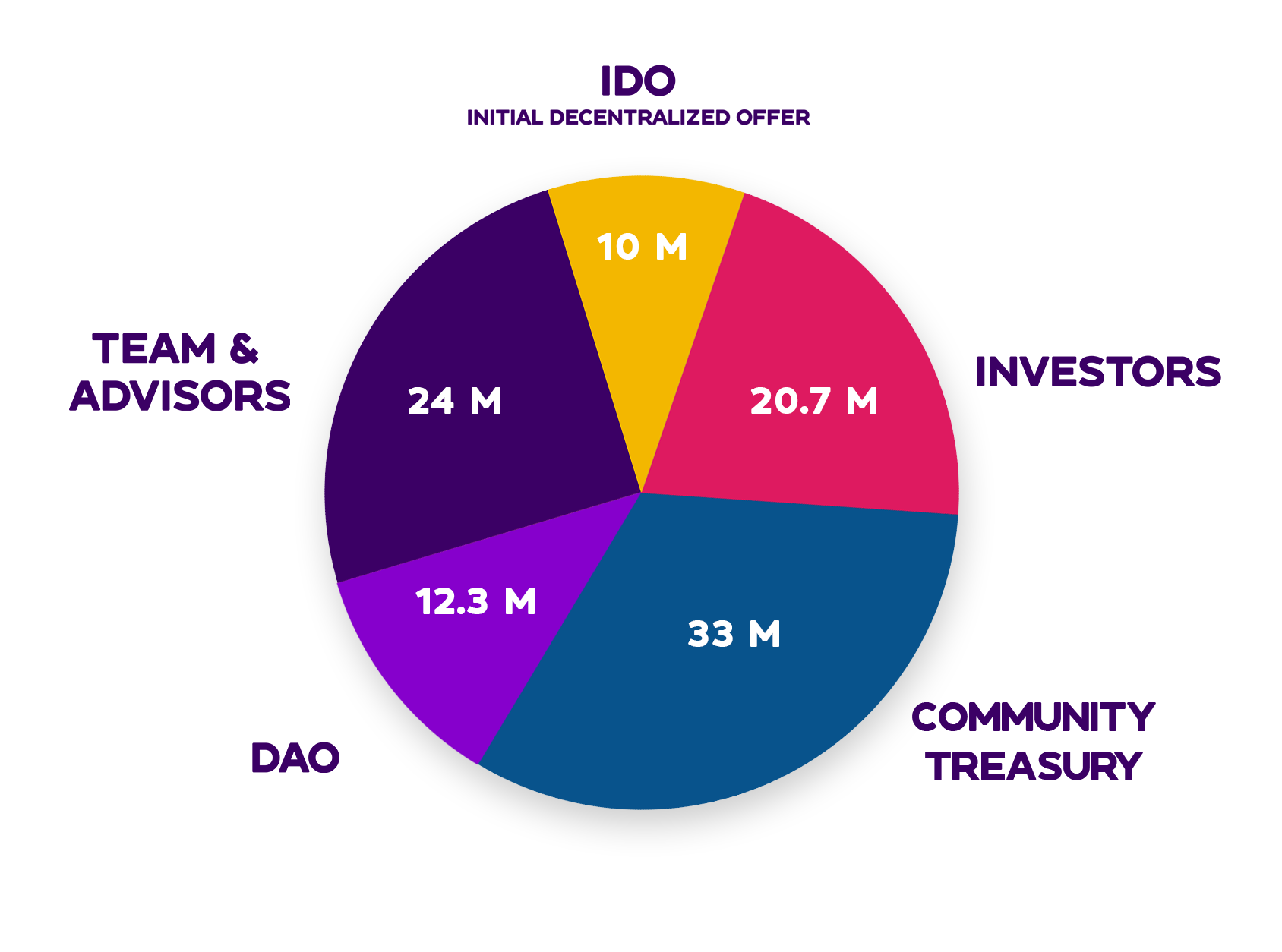
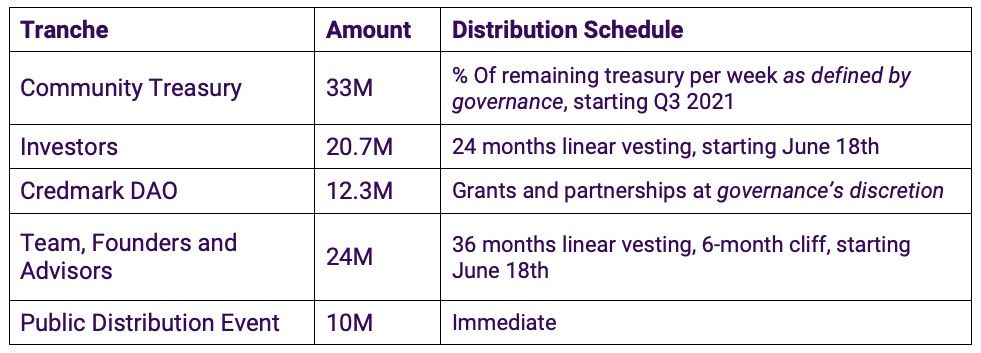
CMK is a limited supply asset, with distribution approaching 100M tokens over the lifetime of the project. The initial circulating supply will include only the Public Distribution Event. The other tranches will vest or distribute as follows:
UNISWAP V3
Uniswap v3 is a complex platform for liquidity providers, while being relatively simple for swap users. Their recent update allows for seamless public launches for token projects without necessarily massive initial capital on the part of the project.
The ability to swap in more of the tokens on a schedule gives downward pressure, a necessary component of price discovery. The liquidity ranges allow the asset price to move, but diminish volatility by progressively shrinking the successive liquidity rangesThe constricting price pressure allows speculators to set the price, and for standard community members to reliably avoid being dumped on.
How do we do this mechanically?
We provide liquidity in several steps. These are a single phase where we provide the initial pool, and it’s corresponding liquidity position. We then start our liquidity drops over the course of three days. Finally, we perform some cleanup and then the token is tradable on the decentralized market.
PHASE 1: INITIAL LIQUIDITY
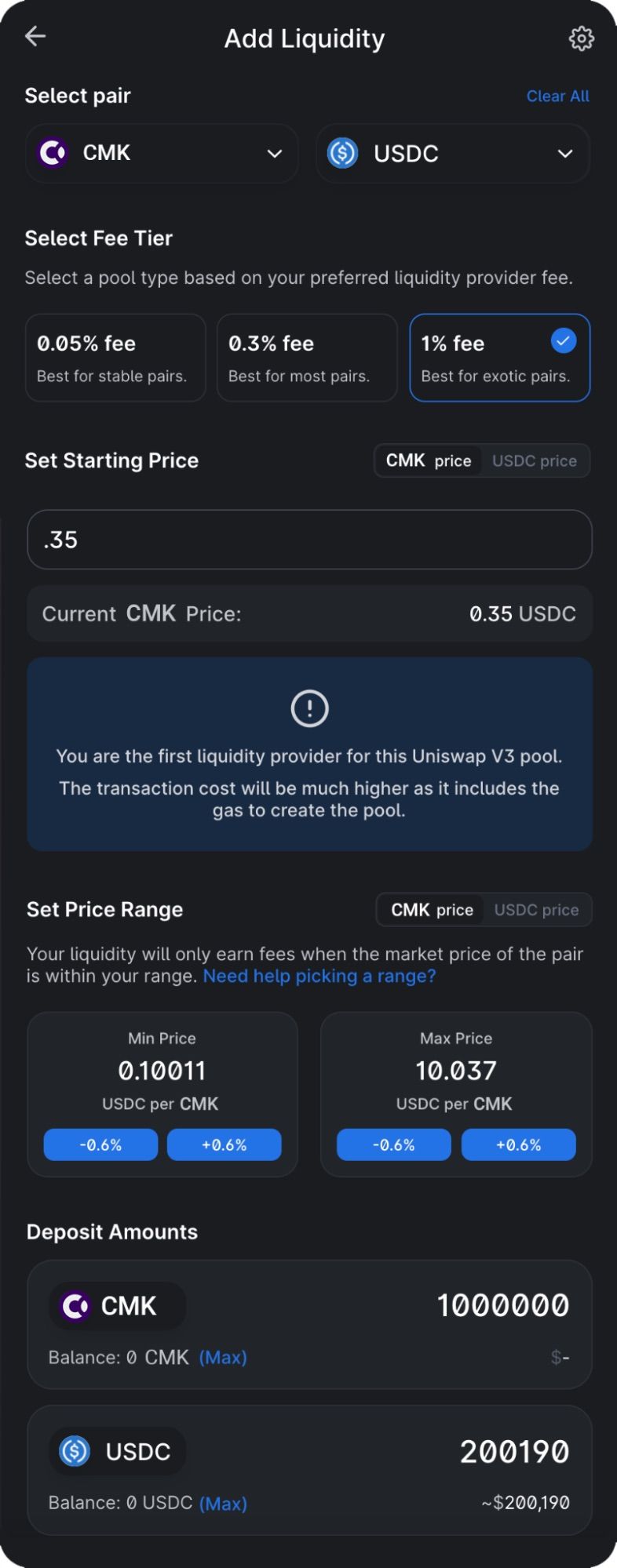
This initial pool allocation has a range from 0.10 to 10.00 USDC. This gives a maximum possible return of 100x, although we set the initial price to the presale price of 0.35 by adding 200190 USDC and 1M CMK. We set the fees at 1% to avoid excessive frontrunning.
The initial liquidity phase will undoubtedly be the most volatile 2 hours of the public launch. We expect the price to oscillate during this phase at the whims of the fickle puppeteers of hype, so to minimize the long term volatility, we will be overwhelming the initial liquidity in the first several hours with more targeted ranges.
PHASE 2: LIQUIDITY DROPS
Every 2 hours for 3 days, Credmark performs a Liquidity Drop of 250k CMK, for a total of 9M CMK. This releases all 10M CMK for the public distribution into the market.
A Liquidity Drop is performed in 2 steps.
Liquidity Drop, Step one: The Swap
Credmark swaps 130k CMK for USDC from the position. This forces the price down, proportional to the liquidity that’s available in that price range.
For example, if the price of CMK is currently 1 USDC, and 130k CMK is representative of a small percentage of the total position value, it will force the price down. The proceeds from this swap are equivalent to the amount of liquidity from 1 to 0.97 USDC.
Credmark has now bought 130k CMK at 0.97 USDC minus the Uniswap Fee (1% of the swap value) for a total of around 125k USDC.
We have 120k CMK remaining from this drop’s initial 250k.
We’ve now added 130k more CMK to the circulating supply, increasing supply within the new range. How can we use these proceeds to add more liquidity to reinforce this price to reduce risk and incentivise accurate price discovery?
Liquidity Drop, Step Two: New Position
Credmark takes the USDC proceeds from the swap, and adds a new liquidity position with 120,000 CMK, extending the lower or upper bands equally, with the width set to slightly less than the previous band’s width. These widths start at ~14.2x, and decrease to ~2.5x.
In our example, we want to add a position of our remaining 120,000 CMK and the swap proceeds of 125k USDC. The price is 0.97 USDC, so we choose a width of 14.2x and center it around the current price, in this case our range is 0.25 -> 3.28.
This will create price support, by supplying more liquidity centered around the new price, while also providing downward pressure in the form of the swap. The liquidity structure we end with will represent a curve supporting the discovered price during the three day period.
At the end of the three day launch period, we will have a liquidity curve that will look something like this, with strong price support in the center.
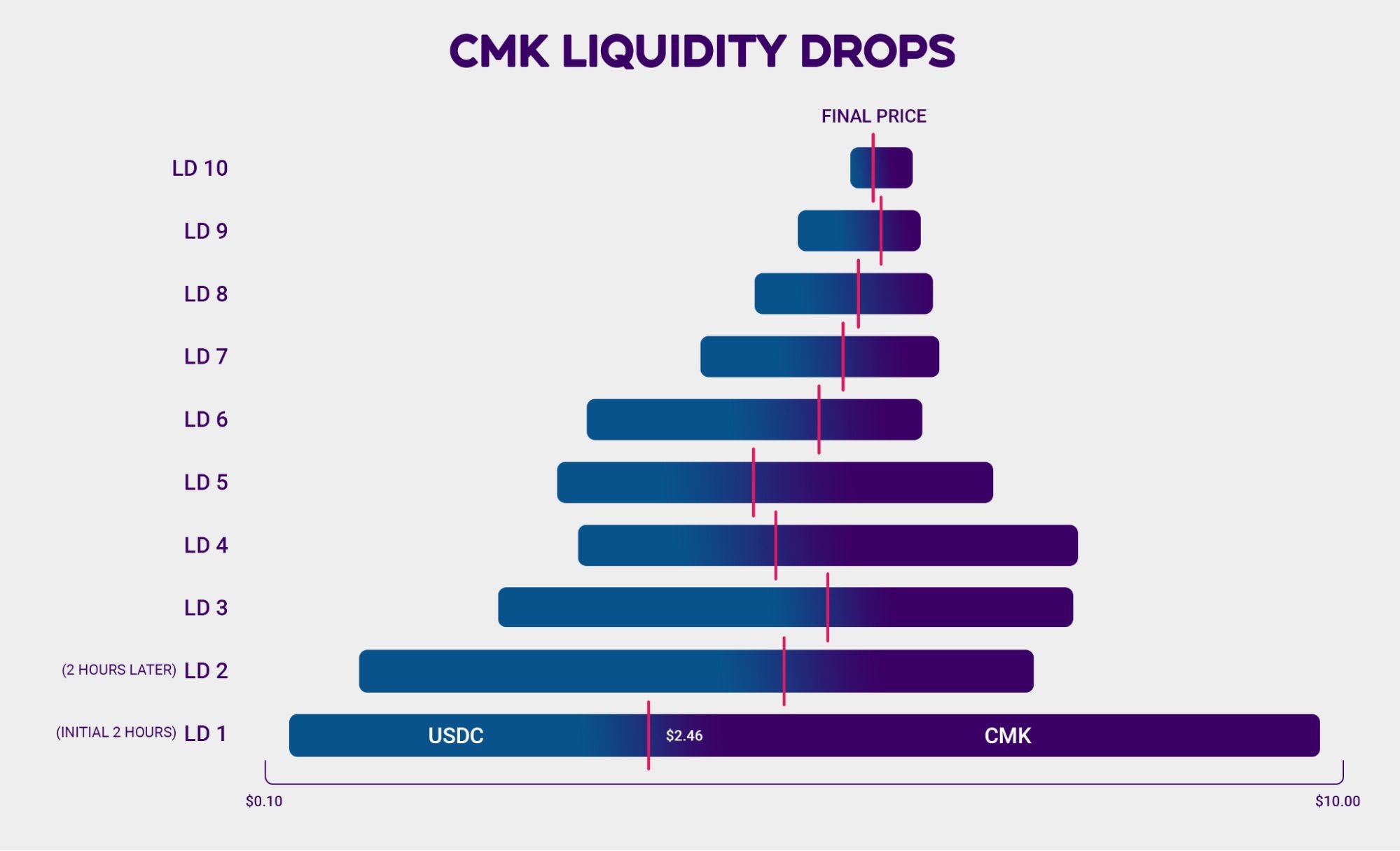
This curve stabilizes our token price around the peak of the curve, and enforces an economic correlation between the two assets.
After each Liquidity Drop there will be a small amount of USDC leftover. This can be used to mitigate frontrunning efforts, execute the cleanup phase, or fix rounding errors in future Liquidity Drops, at Credmark’s discretion.
PHASE 3: CLEANUP
At the end of the three day period, we’ll be left with our initial liquidity position that allows for higher and lower prices than we want. So we’ll remove the initial 1M token position (now dwarfed by 9M CMK at another price) and create another 1M CMK liquidity position that allows for price movements somewhat beyond the curve at our discretion. This allows us to take a small amount of USDC proceeds from the position and reinforce the curve appropriately.
In the months following the launch, we shift the narrower, price irrelevant bands up and down, to keep them relevant to the project and improve capital efficiency, or use them to seed other DEXes, at our discretion.
THE BENEFITS OF THIS METHOD
PRICE SUPPORT
Since such a large percentage of the asset is available in the Uniswap position, this strategy creates a semi-stable asset with respect to USDC in the medium term. This is achieved in our case by strongly correlating our price with that of USDC. Since USDC is stable, it stabilizes the price of CMK.
This is appropriate for the first year of our token, since most early stage projects face internal disincentives from price up events, and demotivation from price down events. Both of these can be troublesome events for a blockchain project.
The price is more volatile at the edges of the liquidity curve than at the center. These price ranges may need to be adjusted with time, especially as the position generates long term fees, in order to prevent upward price pressure from breaking into less sustainable price ranges.
PRICE DISCOVERY
The reason that balancer LBPs are considered the gold-standard for price discovery is the downward pressure that the weight structure imposes over time. By swapping our liquidity and providing the proceeds back into the position, the downward pressure exists without the massive initial volatility downward, and reinforcing the narrowing price support each hour.
FRONT RUNNING MITIGATION
Front running is discouraged in an LSD by
- stabilizing the price curve,
- Uniswap’s swap limits, and
- high fees for high frequency trading.
For more information on front-running, see our blog post.
DISTRIBUTION
This type of public launch is unknown, but it is expected to be similar to an LBP, due to similar price discovery and the long timeframe.
TIMING
Our Liquidity Swap Drop is set to start June 15th at Noon US/Central time and run for 72 hours. If you would like to participate, feel free to join our telegram or discord group to be part of the community, see live AMAs, and participate in virtual social events over the duration of the Launch.

Sign up for our newsletter for the latest product updates, partnerships, and more.